What a Rehab Admission Really Costs: Cost per Admission and Where Organic Lowers It
Most centers know their ad spend. Few know what one admission actually costs them. This article breaks down rehab cost per admission, why paid search keeps getting pricier, how to calculate your own number, and where organic marketing brings it down.
Ask most treatment center owners what they spent on ads last month and they’ll have the number in seconds. Ask them their rehab cost per admission and the room goes quiet.
That’s a problem, because it’s the one marketing number that actually matters. Clicks, calls and impressions tell you something happened. Admissions tell you whether it worked. If your agency reports the first three and never the last, you’re not measuring marketing. You’re measuring motion.
Cost per admission is simple: what you spend to bring in one person who actually starts treatment. Not a click. Not a call. One admission.
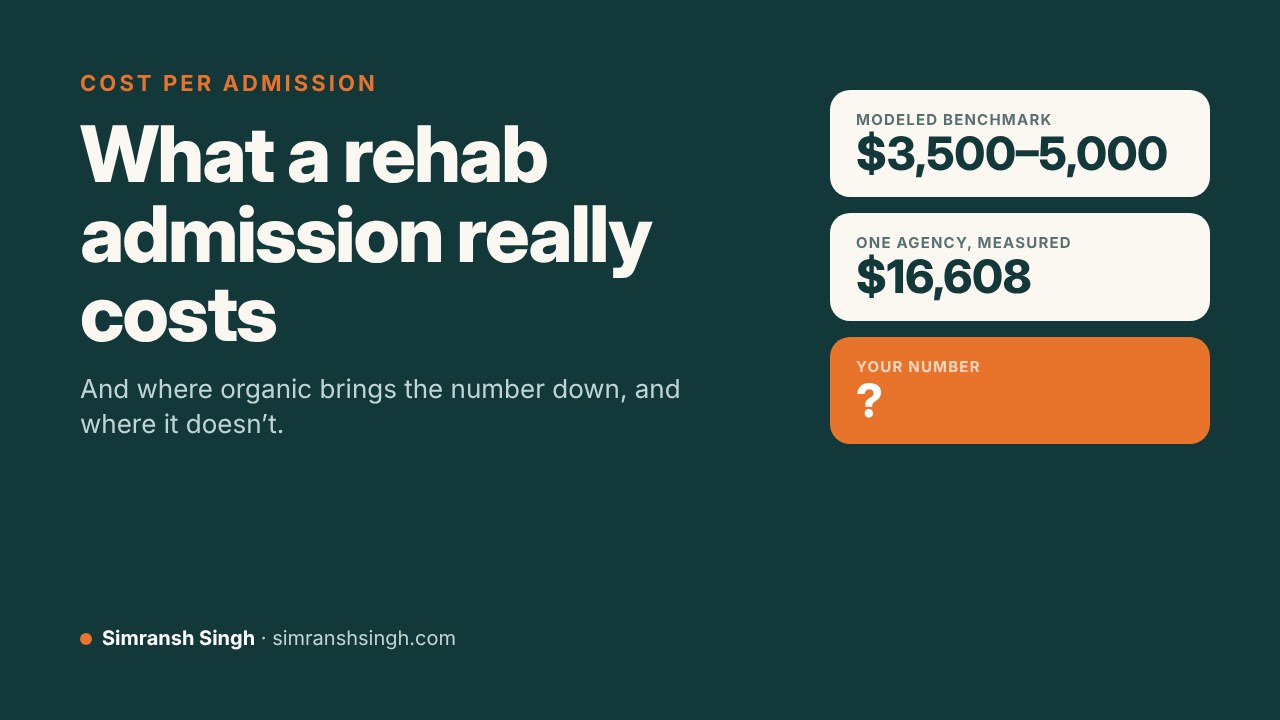
The published numbers are all over the place. One agency puts it at about $16,600 per paid admission, based on a full year of its own clients’ data. Another benchmark says $3,500 to $5,000, but that one is modeled, not measured. Both come from companies that sell marketing. Neither is your number.
And one input is getting more expensive. Recovery.com’s latest Demand Index says Google is forecasting a 17.4% jump in click costs for addiction treatment this quarter.
So here’s what this guide covers: what goes into cost per admission, how to work out your own, where organic marketing brings it down, and, just as important, where it doesn’t.
Why Is Google Ads So Expensive for Addiction Treatment?
Because you can’t just walk in.
Google restricts ads for drug and alcohol addiction services. That covers treatment providers, sober living homes, lead generators and crisis hotlines. In the US, a provider has to be certified by LegitScript and then approved by Google before a single ad can run.
LegitScript is an independent company that checks a provider’s licenses, business model, marketing and affiliations. Its certification is the one Google, Meta, Microsoft Bing and Nextdoor accept for addiction treatment ads.
That costs money before you’ve bought a single click. For centers with one to nine facilities, LegitScript charges a $1,595 application fee and a $3,095 annual fee, per facility. The application fee isn’t refundable, and the annual fee kicks in once you’re approved. For one facility, that’s $4,690 in year one. And not everyone gets through.
The gate keeps some people out. It doesn’t make the auction cheap. Here’s why, and this is my read of the market rather than a measured fact:
- An admission is worth a lot to a center, so everyone bids hard.
- The person searching usually needs help now, so the clicks convert.
- Policy limits what you can say in an ad, so there’s less room to improve the copy and bring costs down.
And there are plenty of bidders. SAMHSA’s 2023 facility survey covered 14,620 substance use treatment facilities across the US, and about four in ten substance use facilities are privately run for profit, according to KFF’s analysis of SAMHSA data.
The price trend points one way. Across all industries, the average Google Ads click was $5.26 in 2025 (WordStream). For drug and alcohol rehab programs, Recovery.com reports that average click costs rose 3.8% in the first nine months of 2026 compared with the same months of 2025, and Google is forecasting another 17.4% rise in Q4. Recovery.com sells advertising to providers, so treat that as a market signal, not an independent audit.
Paid search works. But it’s the one channel where you’re renting attention, at a rising price, from behind a certification wall.
What Does Rehab Cost per Admission Actually Include?
At its simplest: total acquisition cost divided by admissions.

The catch is what goes into the “total cost” part. Most centers count media spend and stop there. They leave out agency fees, tools and the hours their admissions team spends chasing those leads. That makes every channel look cheaper than it really is.
A few terms worth knowing:
- Cost per click (CPC): what you pay each time someone clicks an ad.
- Cost per lead (CPL): what you pay for a call or a form fill.
- VOB (verification of benefits): checking what someone’s insurance covers before they’re admitted.
- Admissions funnel: the path from first contact to admission. Lead, then VOB, then admission.
There’s also a quick shortcut: cost per admission = cost per lead ÷ lead-to-admission rate.
Here’s why that shortcut matters. Webserv, a rehab marketing agency, published its 2025 numbers across its clients’ paid media: about $16.5 million in spend, 40,652 leads at roughly $406 each, about 6,470 VOBs and 994 admissions. Only about one in six leads reached a VOB. Fewer than 3 in every 100 became admissions. Divide $406 by that 2.4% and you land near $16,600 per admission.

A cheap lead is not a cheap admission.
How Much Does It Cost to Get an Admission at a Rehab Center?
Honestly, nobody can give you a clean answer, and anyone who does is usually selling something.
Webserv’s measured figure is $16,608 per admission across its clients’ paid media in 2025. CUFinder’s 2026 benchmark says $3,500 to $5,000, but CUFinder describes its figures as projections modeled from healthcare ad data, not numbers measured at treatment centers.

Use them as bookends, not a price list. Your payer mix, level of care, location and how fast your team calls people back will all move your number. That’s why you need to work out your own.
A Worked Example (Illustrative)
These numbers are made up to show the math. They are not benchmarks.
Say a center runs paid search for one month:
- Media spend: $40,000
- Agency fees: $6,000
- Call tracking and CRM: $1,000
- Admissions staff time on paid leads: $5,000
- Total: $52,000. Paid admissions: 4. Cost per admission: $13,000.
Now the center adds an organic program. Its clinicians record short, plain-language videos. It publishes a few clear articles, tidies up its Google Business Profile and starts following up with people who engaged with its content. Say that runs around $4,000 a month, and a good part of it is staff time the center already pays for.
Months one and two: about $8,000 spent, no admissions you can tie to it. Months three and four: intake logs one admission a month where organic played a part. Months five and six: two a month.
Over six months, organic costs about $24,000 for six admissions, or $4,000 each. In month six alone, it’s $2,000 each. Paid stays at about $13,000 for as long as you keep buying.

Now look at the blended number. In month six, the center has four paid admissions and two organic ones. Total cost: $52,000 plus $4,000, or $56,000. Total admissions: six. Blended cost per admission: about $9,300, down from $13,000, without anyone touching the paid budget.
That’s the real case for organic. It doesn’t replace paid. It pulls the average down.
But read it carefully. The first two months show nothing. If a board member looked only at month two, they’d call the program a failure. They’d be looking at the wrong month.
Admissions are also shared. A family might watch a clinician video, search your name, then call from an ad. Both channels touched that admission. Which one gets the credit? Neither, until you ask at intake. That’s why the intake question in the self-check below matters more than any dashboard.
And again, these numbers are invented. Organic doesn’t always win. If your clinicians won’t go on camera, or intake doesn’t follow up, month six looks just like month one. Learn the math here, then swap in your own figures.
Where Does Organic Lower Cost per Admission, and Where Doesn’t It?
Organic marketing means earning attention instead of renting it. That includes showing up in search, a strong Google Business Profile, clinician-led content, replying to reviews, alumni referrals and a way to reconnect with people who’ve already engaged.
Where It Helps
It warms up the first call. A lot of admissions start with a family member or friend, not the person who needs treatment. SAMHSA’s treatment admissions data shows “self or individual” referrals, which include family and friends, grew from 36% of admissions in 1993 to 48.4% in 2022. (I dig into this in Same Age, Different Generation.) That person looks you up before they call. If they find clear answers and a real clinician, the call starts with trust instead of suspicion. Since cost per admission is cost per lead divided by conversion rate, better conversion means a lower cost. That’s reasoning, not a measured result, but it’s the core of how organic pays off.
It makes your ads work harder. Someone who clicks an ad for a center they already recognize is more likely to call than someone clicking on a stranger. Same spend, more admissions.
It takes the fear out of intake. A family that has already read your insurance explainer and seen what the first week looks like arrives with fewer questions. Shorter calls. Fewer drop-offs.
It keeps working. A good clinician video or article is still doing its job next quarter. A click is gone the moment it’s paid for.
It reconnects with warm people cheaply. Reaching people who’ve already engaged with your content, on the platform where they engaged, costs far less than finding strangers, and it doesn’t need patient lists or tracking pixels.
Where It Doesn’t
It takes time. In my experience, organic usually needs a few months before it shows up in admissions, often three to six. Paid can bring calls this week.
Attribution is messy. Organic rarely gets last-click credit. Without an intake question, you’ll undercount it.
It depends on people. Someone has to be on camera, someone has to publish, someone has to answer. No people, no program.
It can’t fix a slow phone. If intake takes hours to call back, the trust you built leaks out.
Compliance still applies. HIPAA, 42 CFR Part 2 and FTC rules cover organic content too. No patient stories without written authorization.
Can You Market a Rehab Without Google Ads or LegitScript?
Yes. LegitScript certification is required to run addiction treatment ads on Google, Meta, Microsoft Bing and Nextdoor. It isn’t described as a requirement for publishing your own content. A center can build search visibility, reviews, clinician content and alumni referrals without running a single ad. Platform rules and healthcare privacy law still apply.
Certification is still worth considering. It keeps paid search open to you and tells families you’re legitimate.
What an Organic Marketing Strategy for a Treatment Center Includes
Four parts:
- Content for each stage of the decision: becoming aware, building trust before the call, and the admission itself.
- Clinician-led formats that stay inside privacy rules.
- An intake process that records where the trust came from.
- A way to reconnect with people who already engaged.
I cover the trust stage in detail in the Pre-Decision Trust Blueprint.
How Do You Calculate Your Own Cost per Admission?
Do this once a quarter.

- Pick a 90-day window. One month swings too much, and admissions often come weeks after first contact.
- Add up every cost. Media, fees, content, tools and the share of admissions staff time spent on those leads.
- Count admissions by source. Make one intake question required: “What did you see or read before you called us?” Write the answer down word for word.
- Divide by channel. Paid, organic search, referrals and alumni each get their own number. Keep a blended one too.
- Compare it to real value. Use net revenue collected per admission by payer type, not billed charges.
- Watch the two funnel rates. Lead-to-VOB and VOB-to-admission tell you whether the problem is lead quality, speed or follow-up.
A few things to watch out for:
Don’t use billed charges as value. If you bill $30,000 for a stay and collect $12,000, that admission is worth $12,000.
Don’t sort everything into just “paid” and “organic.” A family that watched a clinician video and then clicked an ad belongs in both until intake tells you otherwise. Record the first touch and the last.
Don’t judge a channel on one month. Admissions lag, and organic lags longer.
And don’t leave this number to your agency alone. Their job is to make their channel look good. Your admissions director and finance lead should see it too.
Your number will move. The direction matters more than any benchmark. If your blended cost per admission drops three quarters in a row, something is working. If it climbs, you know where to look first.
Frequently Asked Questions
How much does it cost to get an admission at a rehab center?
There’s no single price. Published figures run from about $3,500 (a modeled benchmark) to about $16,600 (one agency’s measured paid media data). Work out your own.
Why is Google Ads so expensive for addiction treatment?
Admissions are high value, people searching are ready to act, and certification limits who can bid. Costs are rising too, with Google forecasting a 17.4% click-cost increase in Q4 2026.
How do you get more rehab admissions without paid ads?
Build search visibility, a strong Google Business Profile, clinician-led content, review replies and alumni referrals, then follow up fast. Give it a few months to show up.
What is a good cost per admission for a rehab?
There’s no industry-wide answer. A good number sits well below what an admission brings in, and keeps falling quarter after quarter.
Know Your Number First
Cost per admission connects marketing to census. Paid search gives you speed, behind a certification wall, at a rising price. Organic brings the cost down over time, if you build it properly and give it a few months. Most centers need both, in the right order. Start by knowing your number.
Find Where Your Cost per Admission Leaks
Book a free 15-minute call. Bring your last 90 days of lead and admission counts, and we’ll find the leak first.

Simransh Singh builds organic acquisition systems for behavioral health and recovery centers. Connect on LinkedIn.
Sources
- Google, Advertising Policies: Drug and alcohol addiction services.
- LegitScript, Addiction Treatment Certification FAQ and pricing.
- SAMHSA, N-SUMHSS 2023: Data on Substance Use and Mental Health Treatment Facilities.
- KFF, A Look at Substance Use and Mental Health Treatment Facilities Across the U.S.
- WordStream, 2025 Google Ads Benchmarks.
- Recovery.com, Behavioral Healthcare Demand Index, Q3 2026 edition (October 29, 2026).
- Webserv, State of Rehab Marketing 2025.
- CUFinder 2026 addiction treatment benchmarks, as summarized in Webtonic’s rehab marketing statistics.
- SAMHSA, TEDS 2022 Annual Report.
This article is general information. It is not legal, medical or compliance advice.